Carbon Reduction Plan
Supplier name: Beyond Limited
Publication date: July 2026
Commitment to achieving Net Zero
Beyond Holdings Limited is committed to achieving Net Zero emissions by 2035.
Baseline Emissions Footprint
Baseline emissions are a record of the greenhouse gases that have been produced in the past and were produced prior to the introduction of any strategies to reduce emissions. Baseline emissions are the reference point against which emissions reduction can be measured.
Baseline year:
FY21 (1 April 2021 . 31 March 2022)
| Scope & Category | Source | Emissions (tCO2e) | |
|---|---|---|---|
| Scope 1 | Natural gas for office heating | 12.10 | |
| Scope 2 | Purchased electricity – location-based | 5.66 | |
| Purchased electricity – market-based | 0.00 | ||
| Scope 3 | Cat 4 | Upstream transportation & distribution | NA |
| Cat 5 | Office waste and wastewater | 0.03 | |
| Cat 6 | Business travel | NA | |
| Cat 7 | Employee commuting | 1.47 | |
| Cat 9 | Downstream transportation & distribution | NA | |
| Cat 1* | Third-party data centres (market-based) | 0.90 | |
| Cat 3* | Fuel & energy-related activities: Gas WTT and Electricity T&D losses | 2.46 | |
| Total Scope 1 & 2 (market-based) | 12.10 | ||
| Total emissions for S1, S2 & S3 categories 4,5,6,7,9 (market-based) | 13.60 | ||
| Total for all reported emissions, including voluntary categories* | 16.98 | ||
* Voluntarily reported categories beyond the minimum required by PPN 006. These are disclosed for transparency and to inform carbon reduction planning but are not included in the headline reduction targets.
Additional Details relating to the Baseline Emissions calculation:
The baseline emissions have been calculated for Beyond’s operations in line with PPN 006, the GHG Protocol Corporate Standard, the GHG Protocol Corporate Value Chain Scope 3 Standard and relevant UK Government conversion factors.
Scope 1 includes natural gas used for office heating. Scope 2 includes purchased electricity, reported using both location-based (LBM) and market-based methods (MBM).
The five Scope 3 categories required under PPN 006 have been reviewed and included where applicable. Upstream and downstream transportation and distribution (T&D) are considered not applicable or immaterial due to Beyond Holdings Limited’s digital service model and limited movement of physical goods. Waste and employee commuting have been estimated using national statistics and consistent methods across both reporting years. Business travel data was not available for the baseline year, but processes are now in place to capture this data going forward.
Additional material emissions from third-party data centres (category 1) and fuel and energy-related activities (category 3), including gas well-to-tank (WTT) and electricity transmission and distribution (T&D) losses, have also been reported voluntarily to provide a more complete basis for carbon reduction planning. These voluntary categories are not included in the headline reduction targets.
Current reporting year:
FY25 (1 April 2025 . 31 March 2026)
| Scope & Category | Source | Emissions (tCO2e) | |
|---|---|---|---|
| Scope 1 | Natural gas for office heating | 6.13 | |
| Scope 2 | Purchased electricity – location-based | 17.17 | |
| Purchased electricity – market-based | 0.00 | ||
| Scope 3 | Cat 4 | Upstream transportation & distribution | NA |
| Cat 5 | Office waste and wastewater | 0.06 | |
| Cat 6 | Business travel | 10.19 | |
| Cat 7 | Employee commuting | 10.95 | |
| Cat 9 | Downstream transportation & distribution | NA | |
| Cat 1* | Third-party data centres (market-based) | 81.40 | |
| Cat 3* | Fuel & energy-related activities: Gas WTT and Electricity T&D losses | 2.79 | |
| Total Scope 1 & 2 (market-based) | 6.13 | ||
| Total emissions for S1, S2 & S3 categories 4,5,6,7,9 (market-based) | 27.34 | ||
| Total for all reported emissions, including voluntary categories* | 111.54 | ||
* Voluntarily reported categories beyond the minimum required by PPN 006. These are disclosed for transparency and to inform carbon reduction planning, but are not included in the headline reduction targets.
Location-based electricity emissions have increased since the baseline year, reflecting increased office occupancy and equipment use. Market-based Scope 2 emissions remain zero through the procurement of certified renewable electricity.
Emissions reduction targets
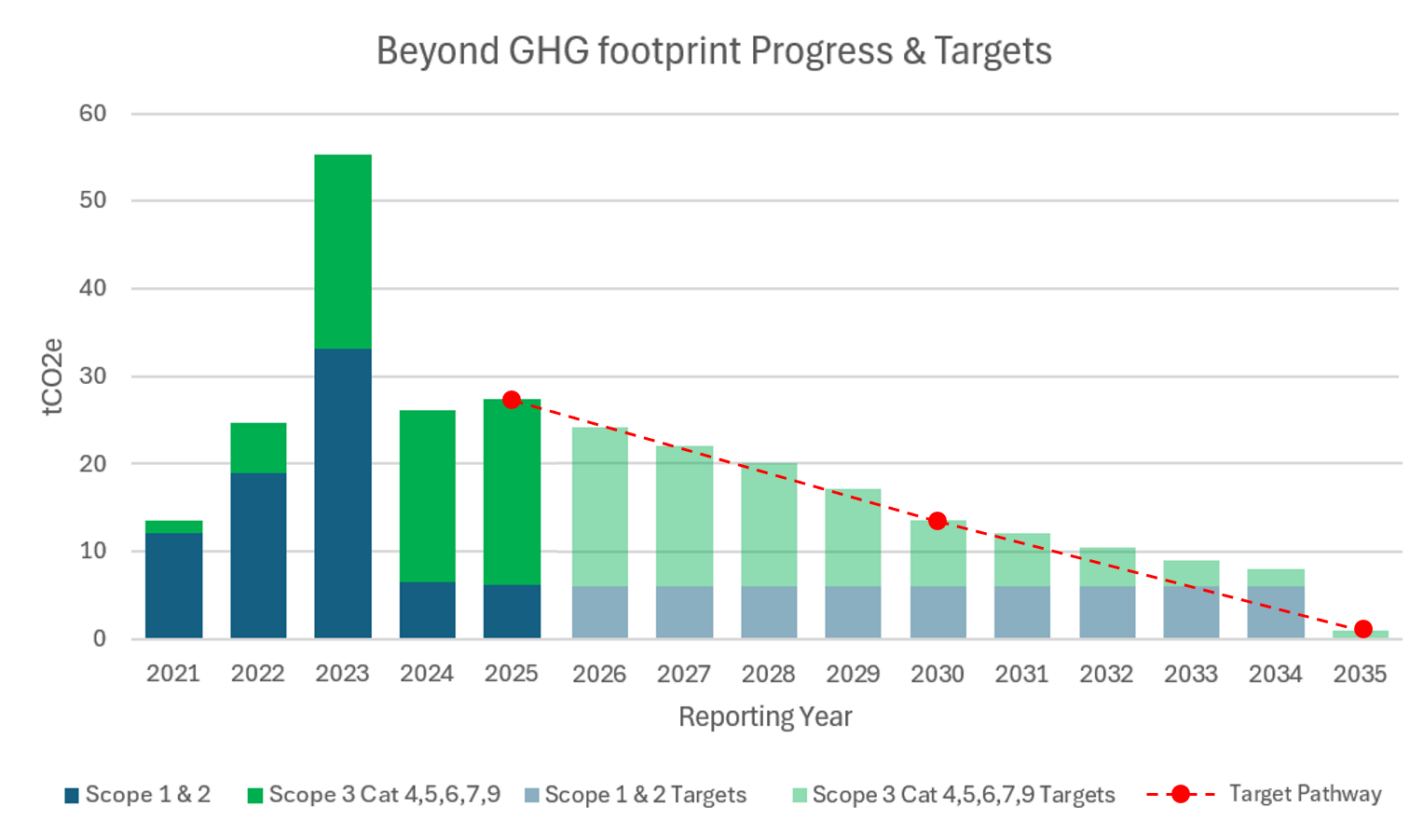
Beyond is committed to achieving Net Zero emissions by 2035 across the reported emissions footprint covered by this Carbon Reduction Plan. This includes Scope 1, Scope 2 and the five Scope 3 categories required under PPN 006 (categories 4, 5, 6, 7 and 9).
Against the current (FY25) reported in-scope footprint of 27.3 tCO.e, Beyond has set the following targets:
- Reduce in-scope emissions by approximately 50% by FYE30 (to no more than 13.7 tCO.e); and
- Reduce in-scope emissions by at least 95% by FY35 (to no more than 1.4 tCO.e), with remaining residual emissions addressed through credible, verified carbon credits.
To achieve these targets, Beyond will:
- Electrify heating to remove gas and remaining Scope 1 emissions by 2035 at the latest;
- Continuing to procure electricity from certified renewable energy sources to ensure market-based Scope 2 emissions remain at zero;
- Improve business travel and employee commuting data to improve accuracy and better inform sustainable travel strategies and supporting initiatives;
- Monitor low-materiality categories, such as waste, to ensure they remain proportionate and accurately reported.
Beyond recognises that residual emissions are likely to remain within the five required Scope 3 categories, particularly where emissions sit outside its direct operational control. In line with recognised Net Zero principles, Beyond will prioritise reducing emissions across its value chain and will then use credible, verified carbon credits to address residual emissions that cannot be eliminated.
Progress to date and the target pathway for future years are illustrated below.
Carbon Reduction Projects
Since the FY21 baseline, Beyond has implemented a range of carbon reduction measures focused on energy efficiency, sustainable travel and operational improvements, outlined below.
By shifting to certified renewable electricity and implementing heating efficiency initiatives, Beyond has reduced its Scope 1 and 2 (market-based) emissions by approximately 6 tCO.e, a 49% reduction compared with the FY21 baseline.
Reported Scope 3 emissions have increased since the baseline year. This is primarily due to improved data capture and the inclusion of business travel, which was not captured in the FY21 baseline and now accounts for approximately one-third of in-scope Scope 3 emissions. This change improves the completeness of Beyond’s reporting and provides a stronger basis for future reduction measures.
The measures already implemented will remain in effect when performing the contract, where relevant to the scope of work and within Beyond’s operational control.
Actions taken since the baseline include:
- Completion of an energy assessment in 2022, which identified the three measures implemented below; together these contributed to the 49% reduction in heating emissions:
- Building fabric improvements, including repairs to windows and roofing, reducing heat loss, improving thermal efficiency and maintaining occupant comfort;
- Optimisation of heating and cooling controls, including the automation of air-conditioning timers to prevent unnecessary energy consumption outside operational hours;
- Upgrade of office lighting to energy-efficient LED technology, reducing electricity consumption and maintenance requirements;
- Procurement of certified renewable electricity, avoiding 17.17 tCO.e of location-based emissions in FY25;
- Encouragement of flexible and home-working arrangements, which we estimate reduced employee commuting emissions by approximately 58% (around 15.12 tCO.e) in FY25 compared with a full office-attendance scenario;
- Adoption of a remote-first approach for meetings where practical, reducing business travel and associated emissions;
- Promotion of lower-carbon transport through an employee electric vehicle scheme; and
- Introduction and expansion of a company car-sharing scheme, with three shared vehicles now in operation and 31% of employee travel undertaken through shared transport arrangements.
Declaration and sign-off
This Carbon Reduction Plan has been completed in accordance with PPN 006 and associated guidance and reporting standards for Carbon Reduction Plans.
Emissions have been reported and recorded in accordance with the published reporting standard for Carbon Reduction Plans and the GHG Reporting Protocol corporate standard1 and uses the appropriate Government emission conversion factors for greenhouse gas company reporting2.
Scope 1 and Scope 2 emissions have been reported in accordance with SECR requirements, and the required subset of Scope 3 emissions have been reported in accordance with the published reporting standard for Carbon Reduction Plans and the Corporate Value Chain (Scope 3) Standard3.
This Carbon Reduction Plan has been reviewed and signed off by the board of directors (or equivalent management body).
Director’s signature:

Peter Dabrowa, CEO
July 2026